
Lessons From Hungary

After the disastrous November 2024 elections, the prospects for the survival of American democracy seemed dim. With Donald Trump in the White House and conservative Republicans in control of Congress, the Supreme Court, and most state governments, it seemed certain that they would jiggle the rules in order to ensure that they remained in power indefinitely, even if popular sentiment in the nation moved against them.
What was worse, Trump and his allies had the perfect playbook on which to model their coming coup-that-didn’t-look-like-a-coup. In Hungary, Prime Minister Viktor Orbán, who began his political career as a pro-democracy reformer, had used his election in 2010 as a springboard to restructure both government and civil institutions, thus allowing him to perpetuate his rule for four terms, sixteen years. Although he and his party, Fidesz, had become widely unpopular, with two thumbs on the scale, Orbán’s election to a fifth term was considered assured. What made Hungary so appealing to Trump was that everything Orbán had done was perfectly legal. He merely exploited weaknesses in post-communist Hungary’s constitution and used laws that had been written to promote democracy to destroy it.
Orbán and Fidesz had won in a landslide in 2010, capitalizing on a devastated economy to sweep the scandal-ridden socialists from power and gain a two-thirds supermajority in the national assembly. That two-thirds allowed Orbán to rewrite the constitution, which he promptly did. He drastically reduced the number of seats in the national assembly and then gerrymandered what was left to make Fidesz almost impossible to beat. The party achieved the requisite two-thirds in 2014 and 2018, despite receiving less than fifty per cent of the votes in either of those elections.
In addition to rigging the electoral system, Orbán reduced the powers of the constitutional court and the judiciary and then staffed them with like-minded stooges and opportunists. He took almost total control of the press and other outlets, giving himself the power to cancel media licenses and assess journalists hefty fines or even put them in prison for criticizing the government.
Orbán does not mince words. He openly described Hungary’s government as an “anti-woke illiberal democracy” and enthusiastically embraced racism, Christian nationalism, and discrimination against the LGBTQ community. He has offered bribes to ethnic Hungarians to have more (white Christian) children. He erected a barbed-wire fence at the nation’s border to keep out migrants.
It is difficult to envision an agenda more appealing to Donald Trump.
But, as in the United States, Orbán’s governance left much to be desired. Hungary’s economy became one of the weakest in Europe, all while Orbán and his cronies were getting rich through a series of malodorous deals and giveaways. Inflation soared while real wages plummeted and investment in health care and infrastructure dried up. By early 2026, unemployment and underemployment, especially for younger Hungarians living in cities, had reached a ten-year high.
In foreign affairs, Hungary became a good deal more like the vassal state of Russia it had once been than the fledgling democracy it had worked so hard to become. Thus, Orbán became a MAGA darling.
None of this sat particularly well with the electorate, but Orbán seemed to feel little need to worry. With a national election due in April 2026, it was estimated that he would need to lose the popular vote by at least ten percent to even begin to be worried about losing his supermajority, and by a good deal more than that to be turned out of power.
But, living in an echo chamber, surrounded by toadies, Orbán failed to appreciate that many of his one-time supporters were a good deal angrier with him than he thought.
But Peter Magyar, who had been a mid-level Fidesz official, did not.
Magyar, a centrist conservative, joined the recently formed Respect and Freedom Party, Tisza, and mounted a challenge to Orbán and Fidesz. At first, he was given little chance but as Hungary’s economy continued to sag and Orbán’s policies continued to lose popularity, independent polls, of which few remained, forecasted a closer than expected election. As election day approached, Median, the most respected pollster in Hungary, predicted that not only would Tisza win but that it might gain the two-thirds supermajority that would allow legislators to undo all the anti-democratic changes Orbán had shoehorned in.
Median was right. Spurred by a massive turnout of Hungarians young and old who refused to believe there was no hope, not only did Tisza win, but it easily cleared the threshold of 133 seats necessary to make the changes so many craved. After about three-quarters of the votes had been counted, Orbán threw in the towel. Across Hungary, there was dancing in the streets.
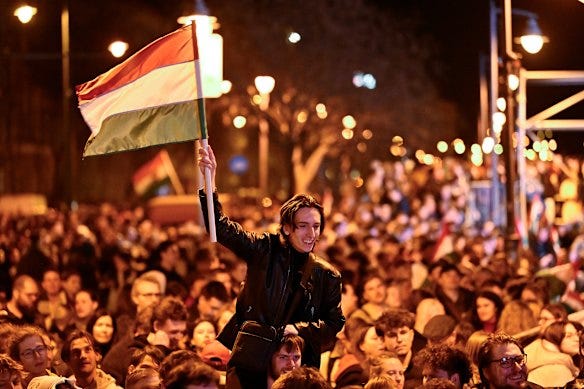
Many were stunned that Orbán conceded. After sixteen iron-fisted years in power, with all the chicanery he had employed to remain in charge, and a constitutional court in his hip pocket, why would he have been willing to simply give up?
The answer is he had not been planning to. Even before the votes were counted, Fidesz supporters were accusing Tisza of fraud and Orbán himself, early in the counting, said, “There are too many votes.”
But in the end, he had no choice. His defeat was so huge, so profound, that no fraud charge would have been even remotely plausible. Fidesz lost a whopping 80 seats, dropping from 135 in 2022 to 55, while Tisza won 81 seats more than the opposition four years earlier. Orbán lost nationwide, including in districts in which he had previously run up hefty majorities, and unless he opted to try a military coup to stay in power and perhaps even then, Hungary would have erupted. In one news report, Orbán had been heckled during his concession speech by a disgruntled supporter in the front row. Orbán, the reporter said, merely shrugged, as if to say, “What else could I have done?”
And therein lies the lesson. Although it is folly to expect Trump not to scream fraud no matter how much Republicans lose by in November, if the margin is large enough, if voters who want change are committed enough, hamfisted attempts to stack the deck will not be enough. If we show the same determination as the Hungarians who toppled Viktor Orbán, Americans may be able to dance in the streets as well.
From your lips ....