
When Polls (Might) Matter

I don’t usually put a lot of stock in polls as an accurate measure of whatever they purport to be measuring. They are simply too subjective, as evidenced by the significant disparities in the results obtained by different organizations measuring precisely the same thing. To get what they think are solid numbers, pollsters design the questions, choose those few who will be called on to answer them, and then create algorithms to apply the results to a far larger group. Rather than measure the respondents’ biases, pollsters are all too often reflecting their own.
But while poll results are never a scalpel, they are sometimes a sledgehammer and currently there are three areas in which that sledgehammer has pounded out some interesting scenarios for the nation’s future.
The first is presidential approval polls, usually among the least reliable, as is the case with the vastly divergent surveys that claim to reflect how the nation feels about Donald Trump’s leadership. While Insider Advantage recently announced that Trump’s approval was recovering, down only five points, 44-49, Gallup, almost the same day, showed Trump at all-time lows, in the…red…by 24 points, 36-60.
More meaningful are the trends, which, Insider Advantage aside, are all down. This week, for the first time, every poll, including those that seem to query only MAGA hats, show Trump with a net disapproval. Averaging all the polls together, Trump is net negative between 13 and 16 points, worse than Bush, Obama, Biden, and even Trump’s first term. While the shutdown was a spur to the downward trend, the numbers did not improve after the government re-opened but instead have gotten worse.
From the New York Times:
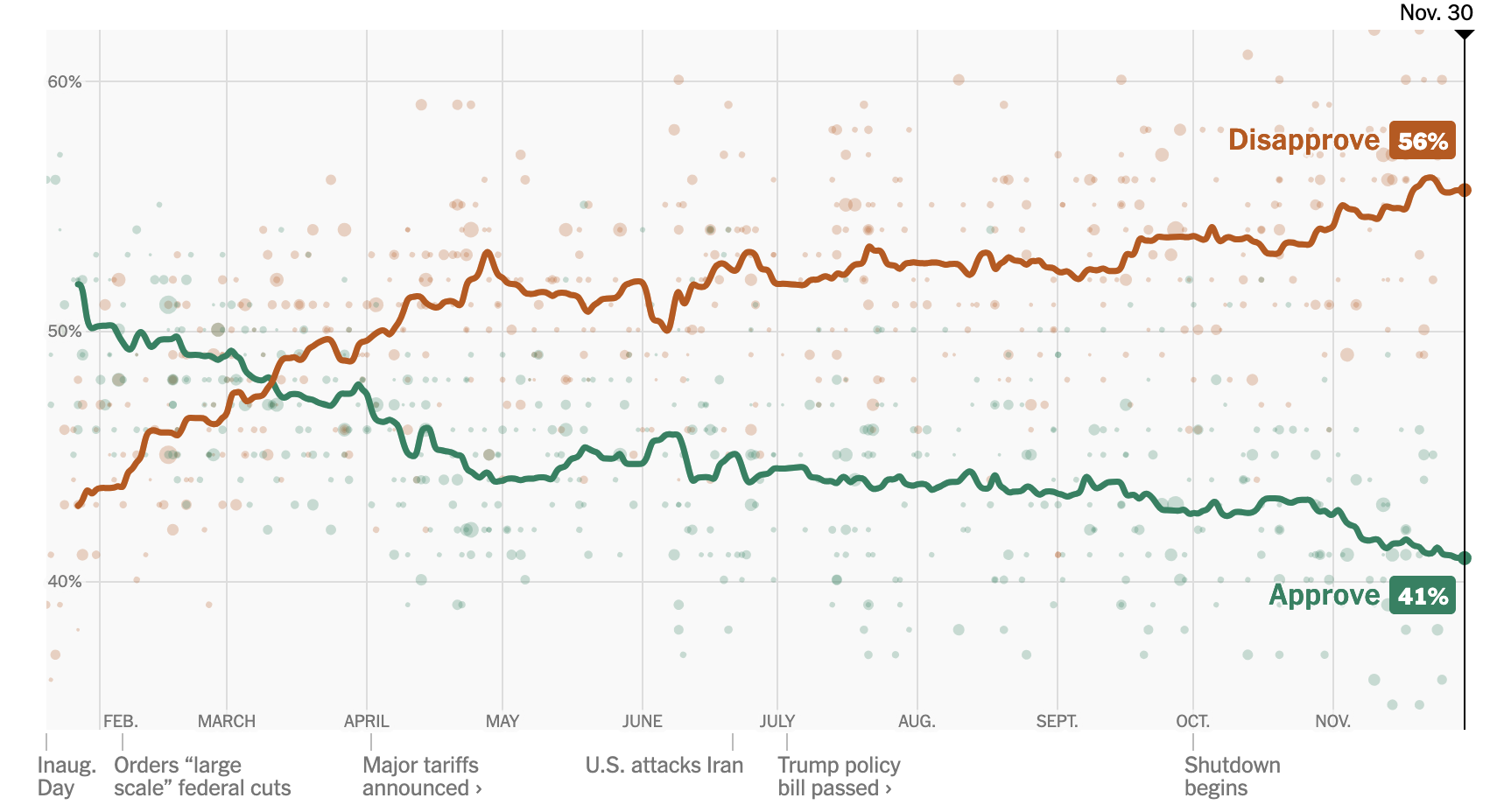
Trump pays attention to these numbers, as do Republicans running for re-election, which may be why many have begun to question or even defy him. Trump himself has gotten increasingly shrill, giving off more than a whiff of desperation. It is unlikely that calling a reporter “piggy” or cozying up to Zohran Mamdani will alter this trend for the better.
The second area is the special election in Tennessee’s 7th congressional district to fill the seat being vacated by Trump loyalist Mark Green. Green had been forced to withdraw from consideration to be Army Secretary during Trump’s first term due to a series of slurs against the LGBTQ community and Muslims. He resigned from Congress in June to pursue a venture in international trade, from which he may well try to piggyback on the Trump family’s influence-fueled self-enrichment crusade. To take his place, Republican West Point graduate Matt Van Epps, with Trump’s full-throated endorsement, is being challenged by Democratic state representative Aftyn Behn, a former social worker and community organizer.
When Green left, neither he nor other Republicans were especially worried about the election to succeed him, which was scheduled for December 2. Trump had carried the district by 22 points in 2024 and expected a hefty margin this time as well.
That confidence may turn out to be premature. The race is not only tighter than expected but, if the polls are to be believed, actually competitive. While two October Democratic-sponsored surveys that showed Van Epps up by only eight points, 52-44, were quickly dismissed, when a pre-Thanksgiving poll by highly respected right-leaning Emerson College, sponsored by right-leaning The Hill, showed Van Epps up only two, 49-47, Republicans began to take notice. They sent heavyweights to the district to hold rallies and poured money into advertising to avoid an upset, which the meager Republican House majority can ill-afford.
Van Epps is still likely to win but the margin will now matter. Although special elections are notoriously unpredictable because of low turnout, they do measure voter enthusiasm. If Behn can come within five to eight points, it will be considered a big win for Democrats, another indicator of what seems a deep and widespread dislike of the way the country is being run. If, however, Van Epps wins by twelve or more, it will reinforce the notion that polls cannot measure the degree of loyalty to Trump and his program.
Which brings us to the third factor, how wrong the polls have been in measuring Trump’s support—to say nothing of ruining Allan Lichtman, who Trump consigned to the prognosticator trash bin. In each of his three runs for the presidency, Trump outperformed most polls, the exceptions generally being those considered Republican-biased. In 2024, after the 2016 and 2020 errors had supposedly been corrected, the same phenomenon occurred and this time underestimation of Republican support rippled down-ballot, especially in Senate races, and left Democrats stunned and disheartened.
As a result, going into 2025, when polls showed key races to be close, especially the gubernatorial elections in New Jersey and Virginia, many Democrats found themselves gearing up for another disaster. In both states, the Republican candidate was a Trump mouthpiece and, especially in New Jersey, had sometimes polled within the margin of error. Other races seemed poised to swing red as well. In Virginia, Republicans felt confident that the Democrats’ newly-gained one seat majority in the House of Delegates would be reversed, expecting to pick up five and possibly ten seats. In state and local elections across the nation, everything from school boards to utility commissions to legislatures, Republicans were confident their recent groundswell of support, especially among Latinos, would be cemented at the ballot box.
As they and we found out on November 4, just the opposite occurred. Both Abigail Spanberger and Mikie Sherrill won by margins far larger than any poll had predicted and Democrats swept to huge wins in state and local elections across the nation. Rather than pick up five Virginia House of Delegates seats, Republicans lost an incredible thirteen. Across New York State, Democrats flipped more than fifty county legislative seats, while Republicans flipped just one. This does not bode well for the likes of Mike Lawler and even Nicholas La Lota, whose once-safe seats might not be so safe after all.
But key is how, for the first time in many years, it was the Democratic turnout that the polls underestimated. That meant, for example, that the huge crowds at the No Kings rallies were not aberrations, but rather a genuine measure of national outrage, which then propelled angry voters, including many who had voted Republican, to pull the lever for Democrats. One of the largest swings was among Latinos, a demographic Republicans desperately need if they expect to maintain control of Congress.
If the polls in the aggregate are correct—and there are many others that support the same conclusion—it will be difficult for Trump to reverse the trend. The only two tried-and-true methods would be war and economic turnaround. But not just war, as in we attack Venezuela or Greenland or Chicago, but war that is provoked after an attack on the United States, as occurred with George Bush after 9/11. And economic turnaround does not mean a roaring stock market or even robust Christmas sales. The first will not impact working class Americans and the second will not improve voters’ moods if their Christmas purchases sent them deeper into debt.
Some months ago, I wrote that Democrats’—and the country’s—only hope was that stupidity and incompetence would stem what then seemed an inexorable slide into fascism. We have since seen more than I expected of both.
The polls seem to agree. I hope this time they are correct.